
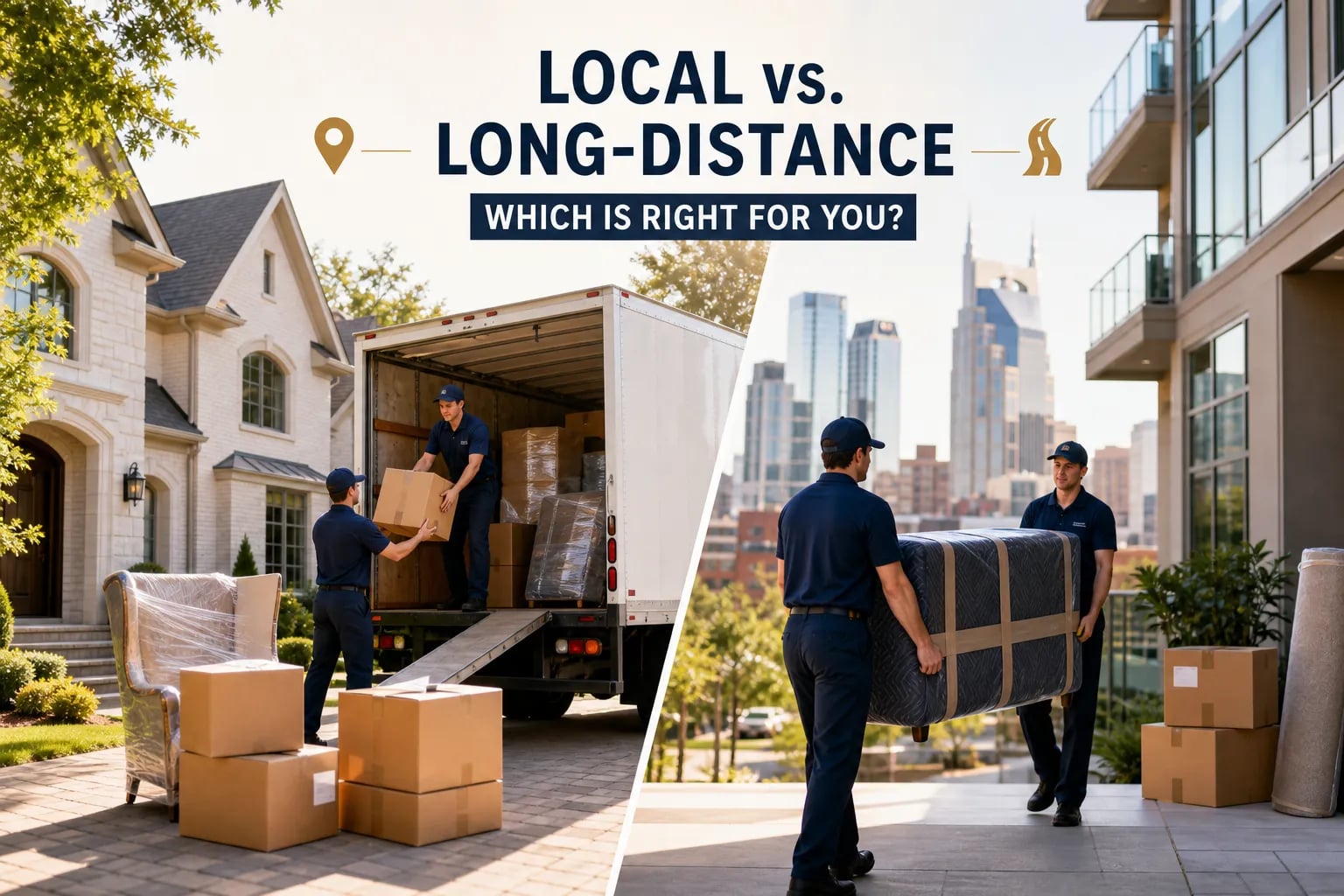
How do I choose between a local and long distance moving company? The answer comes down to two things: distance and who regulates the move. Moves that stay within one state are local and governed by state law. Any move that crosses a state line falls under federal oversight from the FMCSA and is classified as interstate, regardless of how far the truck actually travels. That single distinction changes what license a company must carry, how your price is calculated, what insurance protections apply, and how long delivery takes.
Hiring the wrong type of mover, or hiring a company not properly credentialed for your move type, can lead to unexpected charges, coverage gaps, or disputes with no federal protection to fall back on. The good news is that verifying credentials and comparing pricing models takes less than 30 minutes if you know exactly what to look for. A handful of Nashville-based companies operate credibly in both categories, and understanding the differences helps you confirm who actually qualifies before you sign anything.

Key takeaways
- Jurisdiction, not just mileage: FMCSA classifies a move as interstate whenever a shipment crosses a state line, even if both pickup and delivery are in the same state.
- Different licenses, different rules: Interstate movers need an active USDOT number and MC number. Local movers need state-level authority. Both are verifiable before you hire.
- Pricing models differ completely: Local moves are typically hourly; long-distance moves are priced by weight and mileage, or as a flat rate.
- Insurance protections vary: Federal rules require interstate movers to offer full value protection. Local move coverage depends entirely on state law and contract terms.
- Transit timelines are not the same: A local move finishes the same day; a long-distance move operates on a delivery window that can span 7 to 21 days.
- Binding estimates protect your budget: For long-distance moves, a binding estimate locks in your price. A non-binding estimate can grow after weighing.
What actually separates a local move from a long-distance one?
Most people assume distance is the only factor. The real dividing line is jurisdictional, not geographical. The FMCSA does not use a mileage cutoff. What makes a move interstate is whether the shipment crosses a state line at any point during transit, even if both the origin and destination are in the same state.
The mileage threshold that changes everything
At the state level, most states treat moves under 50 to 100 miles as local, though the exact threshold varies. Within that range, the move is governed by state law, and the company only needs state-level authority, meaning it files with a state agency rather than the federal FMCSA, and your consumer protections come from state statutes rather than federal regulations. Beyond that range, especially across state lines, federal rules take over and the company must carry FMCSA credentials to operate legally.
When an in-state move still becomes interstate
This is the detail most people miss. If a truck carrying your belongings crosses a state line at any point during transit, even briefly, the move is classified as interstate under FMCSA rules. A practical Nashville example: a route from Nashville to Memphis can dip into Mississippi or Arkansas depending on highway routing. If it does, federal law applies to that shipment, and the mover must hold interstate authority. The 100-mile or 500-mile figures that circulate online are industry conventions, not the federal legal standard.
Why the classification matters for you
The classification determines which license a company must hold, which pricing model is legally appropriate, and what consumer protections apply. A local company without FMCSA authority cannot legally move your household goods across state lines. If something goes wrong on an unqualified mover’s watch, you lose access to federal dispute resolution, the formal FMCSA claims process that gives interstate customers a defined timeline and enforceable remedies that state-only complaints rarely match.
How do I choose between a local and long distance moving company based on licensing?
Most people skip credential verification entirely and regret it later. Checking a mover’s credentials takes about five minutes and confirms whether the company is legally authorized to do the work you’re paying for.
What the FMCSA requires for interstate movers
Long-distance companies that cross state lines must carry an active USDOT number and an MC (motor carrier) number. A USDOT number alone does not grant authority to move household goods across state lines. The company must also maintain federal insurance filings, file a BOC-3 process-agent form, and register through the Unified Carrier Registration system. Both the USDOT and MC numbers are searchable for free through FMCSA’s SAFER database. If either number is inactive or missing, the company cannot legally haul your belongings interstate.
What regulates local moving companies instead
Local movers are governed by the state where they operate. In Tennessee, intrastate movers must obtain Tennessee Intrastate Authority through the Tennessee Department of Revenue’s Motor Carrier Division, filed through TNTAP. They must: designate a Tennessee agent for service of process, file proof of liability coverage (Form E), and file cargo coverage (Form H) directly from the insurer. Tennessee intrastate authority does not authorize crossing state lines.
How to verify credentials in under five minutes
For any interstate mover, search the FMCSA SAFER database using the company name or USDOT number. Confirm active MC authority and current insurance status. For local movers, confirm they hold a valid Tennessee Intrastate Authority certificate. JM Moving is licensed and insured, operating under both standards given its active long-distance routes out of Nashville, that kind of coverage on both sides is what you’re looking for when one company handles both move types.
How pricing works for local moves vs. long-distance moves
Pricing is where most people get confused or caught off guard. The models are fundamentally different, and understanding both upfront prevents sticker shock on moving day.
Local move pricing: hourly rates and what actually drives your bill
Local moves are billed by the hour based on crew size. The clock typically runs from when the team arrives to when the last item is placed. Crew size, home complexity, stairs, elevator access, packing needs, and travel between locations all affect the total. JM Moving publishes its local rates upfront: $250 per hour for 2 movers and a truck, $350 per hour for 3 movers and a truck, with no charge for one flight of stairs, elevators, travel time, fuel, or tax on local moves. That level of pricing transparency is what you should expect from any reputable Nashville mover before you book.
Long-distance pricing: weight, mileage, and flat-rate structures
Interstate movers typically price based on shipment weight or cubic footage plus mileage. The further and heavier the load, the higher the bill. Flat-rate pricing, when available, locks in the cost upfront regardless of actual weight. JM Moving’s long-distance flat rates start from $2,500 door to door on its Nashville-to-Miami and Nashville-to-Boston routes. That number is confirmed on a call or walkthrough, not estimated from a web form.
Pricing comparison: local vs. long-distance for a 2–3 bedroom home
| Move type | Pricing basis | Typical cost range (2–3 BR) | JM Moving published rate |
|---|---|---|---|
| Local (under 50–100 miles) | Hourly crew + truck | $1,000–$2,500 | $350/hr (3 movers + truck) |
| Mid-distance in-state | Hourly or flat rate | $1,200–$4,500+ | Confirmed on call |
| Interstate: 100–500 miles | Weight/volume + mileage | $1,300–$5,250 | Starts at $2,500 flat rate |
| Interstate: 500–1,000 miles | Weight/volume + mileage | $2,350–$7,750 | Confirmed on call/walkthrough |
| Nashville to Miami (dedicated) | Flat rate, dedicated truck | $4,500–$10,600 | From $2,500 (confirmed on call) |
| Nashville to Boston (dedicated) | Flat rate, dedicated truck | $4,500–$12,500 | From $2,500 (confirmed on call) |
What hidden fees catch people off guard in each move type?
Both local and long-distance moves carry the risk of add-on charges. The categories look similar on paper, but where costs accumulate is very different in practice.
The most common local move surcharges
For hourly moves, the biggest financial risk is time. Delays, disassembly, slow elevator access, difficult parking, or extra stops all extend the clock and inflate the bill. Stairs beyond the first flight often trigger a per-flight charge. Long carries, when the truck can’t park close to the entrance, add labor time directly. Packing materials, if not included in your quote, can add hundreds of dollars. JM Moving does not charge for one flight of stairs, elevators, travel time, or fuel on local Nashville moves. Confirm this specifically with any mover before booking.
Long-distance charges that inflate the final invoice
Weight overages are the most common surprise on long-distance moves. A non-binding estimate sets an expected number, but the final invoice adjusts once the shipment is weighed. A binding estimate prevents this: the price is locked in for the items and services listed, and the mover cannot demand more at delivery. Under FMCSA rules, if you have a non-binding estimate, the mover cannot hold your shipment until you pay more than 110% of that estimate at delivery, any balance above that must be collected later. Fuel surcharges, shuttle fees when a large truck can’t reach the destination, storage-in-transit, and delivery-window change fees can all appear post-signing if you don’t ask about them before you commit.
What insurance and valuation coverage do you actually get?
Most people assume movers carry full insurance for everything on the truck. That assumption is wrong, and knowing the real rules before you sign protects you from costly surprises.
Released value vs. full value protection: what each pays out
Released value protection, the default on interstate moves, limits the mover’s liability to $0.60 per pound per item. A 50-pound flat-screen television is worth exactly $30 under that coverage. Full value protection sets a higher standard: the mover must repair the item, replace it with a comparable item, or pay its current replacement value. Federal rules require interstate movers to offer full value protection unless the customer waives it in writing. FMCSA sets a minimum coverage floor of $6 per pound multiplied by the total shipment weight. Movers must offer a no-deductible version; reduced-price options with a $250 or $500 deductible are also common. Always ask for the full valuation terms document before signing.
How the claims process differs between move types
Interstate movers follow FMCSA rules: acknowledge a claim within 30 days and settle or deny it within 120 days, with a nine-month filing window from delivery. Local move claims depend entirely on state law and the contract terms. The process can be shorter, longer, or handled through a completely different channel. For either move type, the approach is the same: inspect every item at delivery, document any damage in writing on the inventory sheet before the crew leaves, and photograph everything immediately. Once the crew is gone and the paperwork is signed without noted damage, your claim becomes significantly harder to win.
How long does each type of move realistically take?
Timeline expectations are where long-distance moves most commonly frustrate customers. Local and long-distance moves operate on completely different delivery clocks, and confusing the two leads to poor planning.
Local moves: what same-day delivery actually looks like
A local move, even a large one, is typically completed in a single day. The crew loads, drives a short distance, and unloads to your new address the same day. Your delivery time is a scheduled appointment, not a delivery window. Storage-in-transit, when closing dates don’t align between sale and purchase, is the main scenario that adds a day or more to that timeline.
Long-distance delivery windows and what drives the variance
Interstate delivery timing depends on distance, shipment plan, season, route and the authorized carrier’s written delivery window. Ask whether the shipment uses a dedicated or shared truck, whether storage or transfers are involved, and which legal carrier is responsible before booking. Do not rely on an advertised timeline unless it appears in the written agreement.
Planning around a delivery window
Confirm in writing whether the quoted window is a guaranteed date range or an estimate. Ask specifically whether storage-in-transit is available and what it costs if delivery is delayed. Pack a separate bag, medications, documents, chargers, a change of clothes, and keep it accessible throughout the entire delivery window. Long-distance carriers typically call 24 to 48 hours before arrival, which isn’t much notice if you’re traveling from Nashville to Boston and need to arrange time off.
What a mover that handles both local and long-distance well actually looks like
Most movers specialize in one category, and for good reason. Holding active FMCSA interstate authority, maintaining a dedicated fleet, and running crews at both ends of a route requires significant infrastructure. Understanding what that standard looks like helps you spot companies that can genuinely deliver on both types.
Why most movers specialize in one category
A company handling an interstate move must have the appropriate federal authority or clearly disclose the authorized carrier or broker responsible for the shipment. Ask whether the move is direct or shared, whether transfers are possible, who will handle pickup and delivery, and whose registration and insurance apply. Verify those answers before signing.
JM Moving: one company, own trucks, own crews for both
JM Moving provides Nashville moving services with written pricing based on the inventory, addresses, access, packing needs and requested scope. Local rates and long-distance starting prices must be confirmed on a call or walkthrough. For any interstate shipment, verify the legal carrier, broker status and active operating authority for the specific move before booking. Review the difference between carriers and brokers through FMCSA guidance.
Questions to ask any moving company before you sign
Use this as a practical checklist regardless of which type of mover you’re evaluating. The answers tell you whether the company is credentialed, transparent, and worth booking.
Questions that matter most for local movers
- Do you charge for travel time, fuel, stairs, or elevator access, and if so, what are the exact rates?
- Is your estimate hourly or flat-rate, and what specific items or circumstances would add to the final bill?
- Can I see your Tennessee Intrastate Authority certificate and certificate of insurance before I book?
- What is your crew size for a move of my home’s square footage, and is that included in the quoted rate?
Questions that matter most for long-distance movers
- Are you the actual carrier on this move, or will you broker my shipment to another company?
- What is your active USDOT number and MC number, and can I verify both on the FMCSA SAFER database?
- Is this a binding or non-binding estimate, and what happens if my shipment weighs more than quoted?
- What is your delivery window for my route, and is any part of that window guaranteed in writing?
- What full value protection options do you offer, what are the deductible options, and what items or scenarios are excluded?
- Will the same crew that loads my belongings in Nashville deliver them at the destination, or will there be a handoff?
Making the right call before you book
The decision process has a clear sequence: classify your move first based on distance and state lines, then verify credentials for that category, then compare pricing models and written estimates side by side. Skipping any step in that sequence is where most people end up with unexpected charges or uncovered damage. Knowing whether your move is local or interstate before you call a single company keeps every conversation focused and prevents you from accepting a quote from a company that isn’t legally equipped to do the job.
When you’re asking yourself how do I choose between a local and long distance moving company, the answer isn’t the lowest quote. The right mover is the one that’s properly licensed for your move type, transparent about pricing before you sign, and accountable for the shipment from pickup to final placement. Those criteria, not price alone, are what separate a smooth move from one that ends in a dispute.
JM Moving helps Nashville customers plan local and long-distance moves with written scope and pricing. Call (615) 710-9990 to discuss the route, inventory, access, requested date and current availability. For interstate service, confirm the authorized carrier and required documents for the specific shipment before booking.
Frequently Asked Questions
Can a local mover legally take my household goods across a state line without FMCSA authority?
No, a local mover without FMCSA interstate authority cannot legally move household goods across state lines. If the truck crosses a state line at any point the shipment is classified as interstate and the company must hold active USDOT and MC authority to haul your belongings legally.
How long does it take to verify a mover’s credentials?
Verifying a mover’s credentials takes about five minutes. For interstate movers I confirm active USDOT and MC authority via the FMCSA SAFER database, and for Tennessee intrastate movers I check for a valid Tennessee Intrastate Authority certificate and required insurance filings.
What should I keep with me during a long-distance delivery window?
Keep a separate bag with medications, documents, chargers, a change of clothes, and other essentials accessible throughout the delivery window. Long-distance carriers typically call 24 to 48 hours before arrival, so having these items handy prevents disruption if delivery timing shifts.
What happens if I accept a non-binding estimate for an interstate move?
With a non-binding estimate the final invoice can increase after the shipment is weighed, but the mover cannot hold your shipment at delivery for more than 110% of the written estimate without allowing you to pay later. Any balance above that 110% collected at delivery must be settled later, and choosing a binding estimate locks the price for the listed items and services.
