
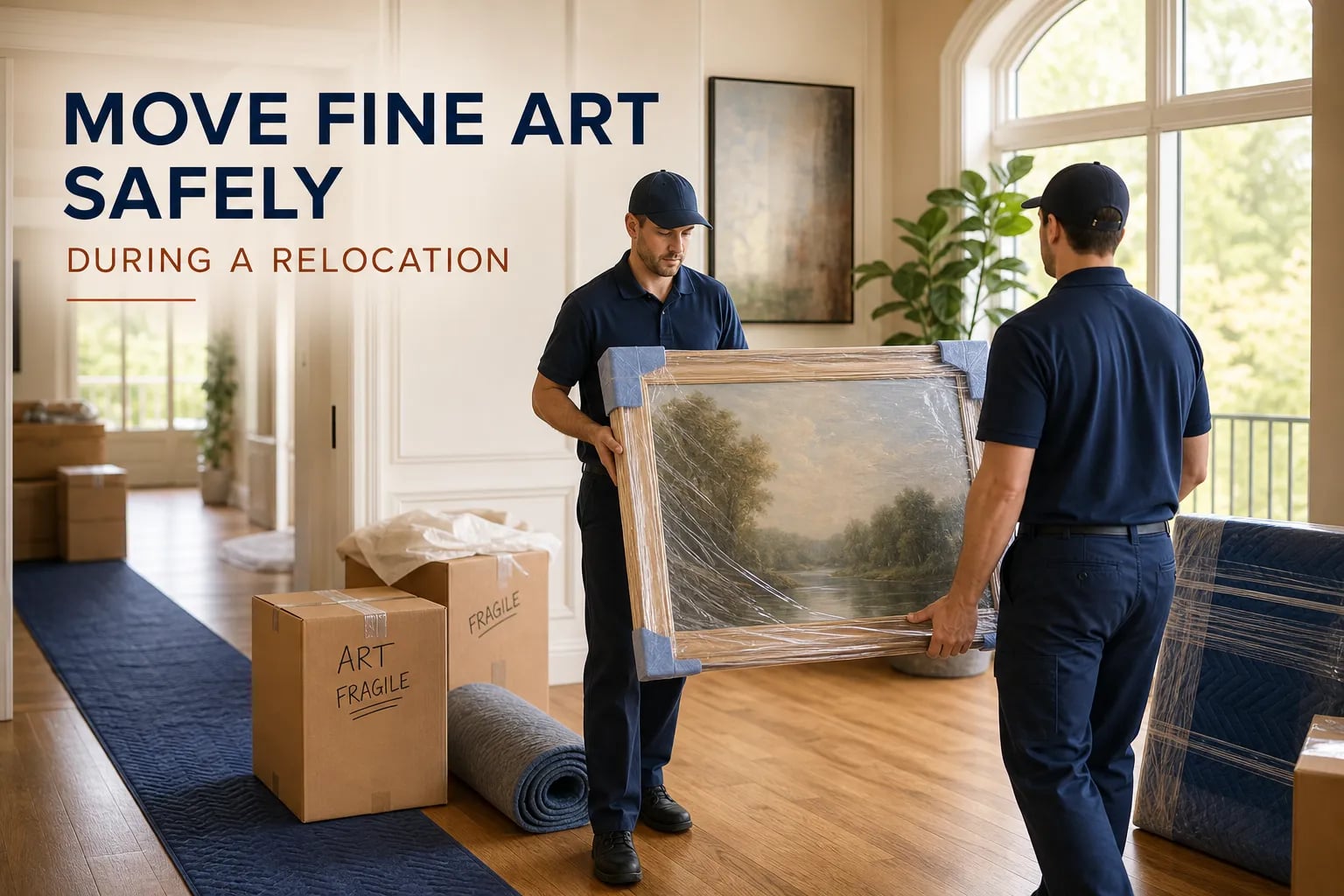
Knowing how to move fine art safely during a home relocation comes down to five things: documenting each piece’s condition before packing, choosing the right materials for its medium, building a layered protective package, controlling the environment in transit, and securing transit insurance that actually matches the work’s value. For high-value or oversized pieces, none of those steps replaces the judgment of an experienced specialty mover. When homeowners in Green Hills, Belle Meade, or Brentwood call JM Moving about a relocation, fine art is one of the first things the team asks about, because it changes how the entire move is planned, from the truck spec to the crew size to the packing sequence.
This guide walks through every step a serious collector needs to understand, whether you plan to handle packing yourself, hire specialists, or a combination of both. By the end, you’ll know what to pack, how to pack it, when to crate it, what insurance to carry, and what questions to ask any mover you consider.

Key takeaways
- Document first, pack second: A signed condition report and thorough photography establish the legal and insurance baseline before a single piece leaves the wall.
- Layered packaging is non-negotiable: Art packing is a system, not a single material. Each layer has a specific job, and skipping any one of them transfers risk directly to the artwork.
- Crating is engineering, not just bigger boxing: Oversized, heavy, fragile, or high-value pieces need a custom wooden crate, not a larger cardboard box.
- Climate matters as much as cushioning: Temperature and humidity swings during transit can crack paint and warp panels without a single bump in the road.
- Standard mover liability is inadequate for fine art: Released-value protection for interstate moves commonly limits recovery to roughly 60 cents per pound per article under federal rules. Pursue all-risk, agreed-value transit insurance instead.
- Specialty movers are not optional for high-value collections: Written condition reports, custom crating, and climate-controlled vehicles are the baseline standard of care, not luxury add-ons.
Document each piece’s condition before you pack a single thing
Documentation is not optional for any artwork with significant value. A signed condition report, front-and-back photography, and a written inventory record establish a legal and insurance baseline before the work ever leaves the wall. Without that paper trail, a damage claim is nearly impossible to substantiate, regardless of what the mover’s contract says.
A proper condition record includes a unique inventory number, artist name, title, medium, unframed and framed dimensions, glazing and frame details, any existing damage or prior repairs, and the declared insured value. The record must be dated and signed by both the owner and the mover at handoff. Store it separately from the artwork itself, and keep a secure digital backup.
For photography, capture a straight-on front and back, edge views from all four sides, and close-ups of every scratch, chip, repair, and any identifying marks including signatures and gallery labels. Preserve the original, unedited files with metadata intact and name each file using the inventory number so records match precisely. Photograph with even, neutral lighting, shadows will hide exactly the detail you need if a claim arises later.
How to Move Fine Art: Packing Materials and Layered Protection
Moving fine art successfully depends on treating packing as a layered system, not a single material. Each layer has a specific job: contact protection, rigid face support, shock absorption, and an outer container. Cutting corners on any single layer shifts the risk directly to the artwork, and the resulting damage rarely looks like negligence, which makes claims even harder to prove.
For framed paintings, the contact layer is archival glassine or silicone-release paper placed directly against the painted surface. Bubble wrap is never the first layer against paint; it can imprint texture and trap moisture. The next layer is a foam-core or corrugated face panel, typically 6 to 13 mm thick, providing rigid face protection. Closed-cell polyethylene foam such as Ethafoam, cut to 25 to 50 mm thickness, wraps around the frame for shock absorption. The outer container is a close-fitting double-wall corrugated picture box, with all interior space filled so the piece cannot shift.
Sculptures follow a similar logic but require a shaped foam nest rather than flat layers, because load must be carried on the piece’s strongest structural points, never on delicate projections or fine details. Works on paper need a foam-core sandwich using two boards at least 13 mm thick, extending about 75 mm beyond the work on all sides, with the whole assembly going into a rigid corrugated mailer. The principle across every medium is the same: the cushioning absorbs impacts, and the artwork never touches the container directly.
How to pack framed paintings and works on paper correctly
Packing an unglazed framed painting follows a clear sequence. Lay glassine against the painted surface, apply foam-core face panels that extend beyond the frame edges, wrap foam corners around all four frame corners, slide the package into a close-fitting double-wall picture box, and seal and label the outside with orientation arrows and a clear “fragile artwork” marking. The piece must be completely immobilized inside the box, any movement during transit transfers directly to the frame corners and, through them, to the canvas or panel.
Glazed works add a layer of complexity. The glass or acrylic facing needs to be immobilized and protected from direct pressure. Corrugated face panels should extend beyond the frame perimeter, and a foam spacer may be needed to prevent the glazing from touching the artwork beneath. For any high-value glazed painting, a custom crate is the responsible choice rather than a carton, because a carton cannot prevent the flex that can crack glass under load.
Flat works on paper require the foam-core sandwich method: two boards, each at least 13 mm thick, with the work interleaved in archival tissue or glassine between them. For works suitable for rolling, use an archival tube with sturdy walls and end caps, with interleaved tissue and the interior end space filled so the roll cannot shift. Not every work on paper can be safely rolled, if you have any doubt, consult a conservator before attempting it. An incorrect roll can cause permanent cracking or deformation in a matter of hours.
Packing sculptures: what changes and what stays the same
Sculptures introduce problems that framed paintings don’t. Irregular shapes, fragile projections, unstable centers of gravity, and surfaces that can’t be wrapped uniformly all have to be addressed with a custom approach. The goal is a fitted foam nest that carries load on the sculpture’s strongest structural areas, not on its most visually prominent or delicate features.
Small, sturdy sculptures under about 30 cm can be nested in a fitted double-wall corrugated box with 50 to 75 mm of foam cushioning on all sides. Isolated protrusions must be wrapped and supported individually before the piece goes into the nest. For large, fragile, or heavy sculptures, a custom wooden crate with internal blocking designed around the specific piece is the correct solution, and that blocking must be engineered to the sculpture’s actual load path.
The triggers for crating a sculpture are clear: the piece is over 30 cm, too heavy for safe hand-carry by the available handlers, has fragile projections that cannot be immobilized in foam, or the move involves multiple handling points such as a long-distance route with a warehouse stop. At that point, a crate is not a premium option. It is the minimum responsible standard.
When does fine art need a custom wooden crate, and what does it cost?
A custom art crate is engineered, not simply a bigger box. Crating is the responsible choice when a piece is oversized, heavy, irregularly shaped, or high-value; when cushioning alone cannot prevent movement; or when the work is traveling long-distance with multiple stops or handling transitions. For Nashville homeowners moving a significant collection, those conditions will apply to more pieces than most expect.
| Crate size | Typical contents/weight | Approximate cost (U.S.) |
|---|---|---|
| Small: up to 2 × 2 × 2 ft | Up to 50, 75 lb | $100, $300 |
| Medium: about 3 × 3 × 3 ft | 75, 250 lb | $300, $800 |
| Large: about 4 × 4 × 4 ft | 250, 750 lb | $800, $1,500 |
| Extra-large or engineered | 750+ lb or oversized | $1,500, $3,000+ |
Price is driven by crate volume, item weight, internal foam and blocking complexity, and whether special treatment is required for international shipping. For domestic Nashville relocations, solid-wood crates do not require ISPM 15 heat treatment or export certification, that standard applies to international shipments only. Domestically, many art shippers still use kiln-dried lumber as a quality measure, but the compliance burden is lower.
The cost comparison is straightforward. Crating a valuable painting typically costs $100 to $800. Damage to a work worth $10,000 or more is another matter entirely, financially and personally, and is rarely recoverable in any meaningful sense. White-glove movers who offer in-house custom crating for fine art and mirrors eliminate the need to source and size a crate separately before move day, reducing both risk and logistical stress.
How to Move Fine Art: Climate Control and Vibration Management
Temperature and humidity swings during a move are the silent threat most collectors underestimate. Paint layers, wood panels, canvas, and paper all expand and contract at different rates. A rapid swing in temperature or relative humidity during transit can crack paint, warp panels, or cause delamination, damage that looks exactly like rough handling but was actually environmental. The target range for mixed collections is roughly 65 to 70°F and 45 to 55% relative humidity, though avoiding rapid swings matters more than hitting any single number precisely.
A climate-controlled vehicle maintains a temperature-regulated cargo area and, in quality art transport, uses air-ride suspension to reduce road vibration. That combination addresses both the environmental and mechanical risks simultaneously. For museum-level sensitivity, microclimate crates with preconditioned silica gel or humidity buffers take control one step further, maintaining stable conditions inside the crate even if the truck environment varies. Data loggers can record temperature, humidity, shock, and tilt throughout the journey, providing documentation if a claim arises.
One of the most common mistakes in DIY art moves is unpacking immediately after a long-distance run. The professional practice, consistent with conservator and museum guidelines, is to leave sealed crates in a stable environment at the destination for 12 to 24 hours before opening. This allows the artwork to acclimatize gradually and prevents condensation from forming on cold surfaces when cold crates are moved into a warm, humid Tennessee interior. A small discipline with a significant protective effect.
What insurance do you actually need for art during a home move?
Standard moving contracts offer released-value protection at roughly 60 cents per pound per item, a federal-law default for interstate moves that applies unless you purchase something else in writing before the move begins. A three-pound painting worth $25,000 would receive about $1.80 in reimbursement under that default. That figure is not a simplification; it is the legal reality.
The coverage you need for moving fine art is all-risk, agreed-value, nail-to-nail transit insurance. Think of the three terms this way: all-risk covers accidental physical loss or damage throughout the move; agreed-value means the insurer accepts the work’s appraised value upfront, eliminating post-loss disputes; and nail-to-nail coverage runs from the moment the work comes off the wall at origin until it is installed at the destination, covering every handling point in between. Fine-art transit insurance typically costs 0.5% to 2% of the declared value per shipment, meaning $500 to $2,000 to insure a $100,000 work, based on industry premium ranges.
Don’t assume your homeowner’s or renter’s policy covers the gap. Most policies restrict or exclude coverage during professional transit, packing, and storage. Confirm coverage in writing before the move begins, and treat any homeowner’s coverage as supplemental rather than primary. Get a written certificate or policy endorsement naming each artwork and the coverage dates before pickup, and photograph each piece’s condition immediately before packing so you have a documented baseline.
Should you hire a specialty art mover for your Nashville relocation?
The practical differences between a specialty art mover and a standard crew show up long before the truck arrives. Written condition notes signed at pickup and delivery, custom crating built to the specific piece, climate-controlled vehicles, trained handlers who know how to carry and orient a framed canvas, and an established claims process backed by real fine-art transit insurance: these are the baseline standard of care for high-value work, not premium upgrades.
JM Moving handles fine art, antiques, pianos, and mirrors with custom crating, written condition documentation, floor runners, door-jamb pads, and corner guards on every qualifying move. The team conducts an in-person or video walkthrough before confirming the price, which means the crew arrives knowing exactly what pieces are involved, what space constraints exist, and what handling the job requires. To learn about service areas, availability, and pricing, contact JM Moving directly for a free flat-rate quote tailored to your collection and move date.
When evaluating any mover for an art-heavy relocation, ask these specific questions: Do they provide written condition reports signed at pickup and delivery? Do they build custom crates in-house or subcontract? Are their crews trained specifically in art handling, or is it a general residential crew? What is their transit insurance policy, and what is the claims process? Can they conduct a walkthrough before providing a final price? A mover who cannot answer those questions clearly is not ready for a fine art collection.
10 fine-art moving tips before pickup
- Photograph the front, back, frame, labels and every existing flaw before packing.
- Give each piece a matching inventory number and written condition record.
- Use glassine or conservation-safe tissue against painted or delicate surfaces.
- Protect every frame corner with fitted foam; never rely on loose blankets alone.
- Keep bubble wrap away from painted surfaces so texture and moisture are not trapped.
- Crate oversized, heavy, unusually shaped or high-value work for the specific piece.
- Keep framed art upright and immobilized; do not stack it flat under household goods.
- Confirm the vehicle, handling plan and any climate requirements before pickup.
- Verify the written valuation and transit coverage rather than relying on a verbal promise.
- Let sealed crates acclimate at the destination before opening when temperature changed sharply.
Need a Nashville fine-art moving plan? Call JM Moving at (615) 710-9990 to discuss the collection, access, packing needs and requested date. Service scope, availability and pricing are confirmed before booking.
Frequently asked questions about moving fine art
Can I pack my own paintings if I buy the right materials?
Yes, for smaller framed works with low-to-moderate value, DIY packing with the correct layered system works well. You need archival glassine, closed-cell foam, foam-core face panels, and a close-fitting double-wall corrugated picture box. For large canvases, glazed works, or anything with significant value, professional packing and custom crating are the appropriate choice, and the shipping artwork tips in this guide apply whether you pack yourself or delegate to a pro.
What is the difference between a crate and an oversized picture box?
A picture box, even a heavy-duty one, is made from corrugated cardboard and relies on the box’s own rigidity plus internal foam for protection. A custom crate is an engineered wooden structure built specifically around the piece it carries, with internal blocking that distributes load to the artwork’s strongest structural points. Crates are appropriate when cardboard’s structural limits would be exceeded by the piece’s size, weight, or fragility.
Does a Nashville relocation require ISPM 15 heat-treated wood in crates?
For moves that stay entirely within the United States, ISPM 15 treatment is generally not legally required. The standard applies to international shipments where solid-wood packaging crosses national borders. Many quality art shippers use kiln-dried lumber domestically as a best practice, but the export compliance requirement does not apply to a Nashville-to-Brentwood or Nashville-to-Miami domestic move.
How far in advance should I schedule an art-focused moving consultation?
For a collection of meaningful size or value, schedule the walkthrough at least four to six weeks before your move date. Custom crates require lead time to design and build, and climate-controlled truck availability can vary by season in Nashville. The earlier you confirm the scope, the better the crew can prepare, and the more accurate your flat-rate quote will be.
What happens if a piece is damaged during the move?
The process starts with the signed condition report completed at pickup. Compare it to the post-delivery condition, photograph any change immediately, and notify the mover in writing before the crew leaves if possible. If you carry all-risk, agreed-value transit insurance, file the claim with the insurer promptly and provide the condition reports, photographs, inventory records, and any applicable appraisal. Without that documentation baseline, claims are extremely difficult to substantiate.
Is climate-controlled transport always necessary for fine art?
For a short local move on a mild day, a standard truck with minimal transit time poses less risk than a multi-day long-distance run through summer heat. However, for any work that is fragile, high-value, on a wood panel, or made with mixed media, climate-controlled transport is the professional standard regardless of route length. A ten-minute drive in a hot truck can cause the same environmental damage as a much longer journey if temperature spikes are severe enough.
Protecting fine art is worth the extra preparation
The five pillars are the same for every collection, regardless of size or value: document thoroughly before anything moves, pack in layers with the right materials for each medium, crate what cannot be safely boxed, manage climate and vibration from origin to destination, and secure transit insurance that actually corresponds to what the work is worth. The preparation is not complicated, but every shortcut carries a direct consequence, and those consequences tend to be irreversible.
For high-value or irreplaceable pieces, the most important decision is not the packing material. It’s who handles the move. An experienced crew arrives prepared with the right tools, constructs crates to fit the specific pieces, documents condition at every handoff, and uses the right vehicle for the job. That combination is what protects a collection through every stage of a relocation.
If you need guidance on how to move fine art safely, JM Moving offers a free flat-rate quote and a pre-move walkthrough to assess your collection, confirm crating needs, and lock in a clear price before move day. Contact JM Moving to get started and make sure your artwork is in the right hands.
